
ISI chief Faiz Hameed coerced the Taliban to announce an interim government guaranteed to preserve Pakistan's control over the levers of power in Kabul, observes Ambassador M K Bhadrakumar.

The India card is now almost obsolete. There are more pressing challenges. People of Pakistan are fed up with years of bad governance, corruption and broken promises of successive governments. However, the politicians and former generals are still provoking sentiments on what is happening on the Line of Control for petty political gains, says Shahzad Raza.

Qureshi said External Affairs Minister Sushma Swaraj sent a letter on Sunday to congratulate Prime Minister Imran Khan and mentioned about talks to resolve issues.

US Secretary of State Antony Blinken was asked by US Congressmen if the US had explore the possibility of northwest India for counter terrorism capabilities in Afghanistan. Blinken's remarks on India assume great importance, observes Ambassador M K Bhadrakumar

'Peace talks with Pakistan are like accepting a dinner invitation from cannibals and hoping to return alive,' says Colonel Anil A Athale (retd).
.jpg)
Pundits in Pakistan and also some western diplomats are predicting that the next army chief will be forced, partly by institutional pressure and partly by circumstances, to indulge in some tough talking with the civilian leadership. How the civil-military equation settles in this sort of a situation is something that will determine the future of Pakistani politics, and also Pakistan's relations with rest of the world, says Sushant Sareen.
'Past experience shows us that cross-border strikes have not prevented Pakistan from continuing with further terror attacks.'

The 68-year-old former first lady was diagnosed with lymphoma (throat) cancer in August 2017.
'Surprised and pained that my name has been dragged into Indian domestic politics,' says Pakistan's former foreign minister Khurshid Mahmud Kasuri.

Former Inter-Services Intelligence chief Ahmed Shuja Pasha has admitted that the deadly Haqqani network was created by it and America's Central Intelligence Agency and claimed that the insurgent group's chief Jalaluddin Haqqani had "in fact been invited to the White House by President (Ronald) Reagan".
India must watch for signs after Peshawar that Pakistan is waking up to the dangers of Islamism, muses Ajai Shukla

'Nawaz Sharif asked: "What if I invited him and he declined?"' 'I said I will check.' 'Vajpayee liked the idea. He said I should see him on my return.' Shekhar Gupta reveals how Sharif wanted to make peace, but was tripped by the army and notes the lessons it has for Imran Khan.

'One of R&AW's greatest achievements is in projecting itself as benign.' 'This work -- done in tandem with the Diaspora and the MEA -- sells a story of India as mostly the victim.'
'The osmosis between Hinduism and Islam that really gave birth to the Hindustani or Indo-Islamic civilisation was due to the conversation between Muslim mystics and yogis.'
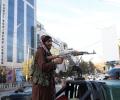
Delhi has come to accept the Taliban takeover in Kabul as a reality and seems increasingly unsure of its dogmatic view of the Taliban as a mere proxy of the Pakistani military and security establishment, observes Ambassador M K Bhadrakumar.

New Delhi has repeatedly missed opportunities for political engagement in Kashmir in the past. It must seize the next one, says Ajai Shukla.

Known for her outspoken nature and unrelenting pursuit for human rights, Asma, 66, was the first woman to serve as the President of Supreme Court Bar Association of Pakistan.

'Whatever the two countries are doing these days, on the diplomatic front and on their borders, that hostility is not sustainable.' 'Today's world doesn't approve it.'

Amit Shah now enters an unfamiliar and interesting phase of his political career. His success or failure will henceforth be assessed based on his performance as a key minister, points out Shekhar Gupta.

'Vajpayee was the first prime minister to visit the battlefield at the height of conflict,' recalls Colonel Anil A Athale (retd).

'By beheading an Indian soldier, the Pakistan army has demonstrated its proclivity for barbaric medievalism.' 'The strategies adopted and the punishment inflicted by India must be made progressively more stringent with every new act of terrorism till the cost becomes prohibitive for Pakistan,' says Brigadier Gurmeet Kanwal (retd).

'When economic policies were attacked by people on his own side, he went ahead despite all the criticisms in the coalition, within the party and the Sangh Parivar.'

Where does the religious preacher and theologian want to take Pakistan?
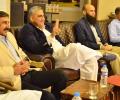
'Over the last year, Bajwa has created the environment to support bold moves on India. The ball is in India's court,' a senior Pakistan military officer tells Ajai Shukla.

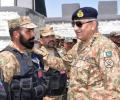
General Qamar Bajwa, his colleagues say, is a firm opponent of extremism and terrorism. He may prove even more forceful in the fight against terrorism than his predecessor, who is credited with launching Operation Zarb-i-Azb, which helped lower the frequency of terrorist attacks.
Prime Minister Khan, in his address, said Pakistan will never fight any other country's war in future and his government's foreign policy will be in the best interest of the nation.

'India has to judge what Pakistan says to us, not what they say to a domestic audience,' a source tells Sheela Bhatt/Rediff.com, explaining why India-Pakistan talks remain on track despite discordant noises from across the border.

By weakening Sharif, the corps commanders could have a final say in important matters like relations with India, dealing with Taliban militants, interacting with Americans and once again achieving strategic depth in post-NATO Afghanistan. Which is why they may be behind the unrest in Pakistan led by Imran Khan and Dr Tahirul Qadri, says Shahzad Raza.

Former Pakistani Inter Services Intelligence boss Hamid Gul was brought under the radar on Monday by the Delhi police after arrested Lashkar-e-Tayiba 'bomb expert' Abdul Karim Tunda revealed that he was in touch with him.

'Kulbhushan Jadhav is a very sad case.' 'I think Pakistan handled this issue very clumsily.' 'They gave too much of publicity and also said that they will hang him.' 'Now obviously, they are not going to hang him.'
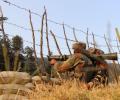
'India has to understand that the permanent state of war that exists between India and Pakistan has to be expected,,' says Colonel Anil A Athale (retd). 'The only way to ensure peace or absence of war is to maintain a militarily-dominant position over Pakistan.'

'Kargil was Pakistan's strategic blunder. India must remain on guard against such sinister operations being launched in future by Pakistan's vengeful and devious military leadership that continues to have a hate-India mindset and the mentality of primitive warlords,' says Brigadier Gurmeet Kanwal (retd).

'In India foreign policy is generally handled by the prime minister.' 'One can clearly see the Vajpayee stamp on all this.' 'Only a person with poetic imagination can weave such a complex web,' says Colonel Anil A Athale (retd).

Only on Wednesday, in his Independence Day speech, Prime Minister Modi said he wants to resolve the Kashmir issue through Vajpayee's doctrine of "Insaniyat, Kashmiriyat, Jamhooriyat" - a testimony to the former PM's lasting legacy.

'The two NSAs, who have been mandated to address mutual concerns on terrorism, will need to devise credible and irreversible measures to see that the likes of Hafiz Saeed and Masood Azhar do not ever get a free hand to run riot again,' says Ambassador G Parthasarathy, India's former high commissioner in Pakistan.

'Nawaz Sharif knows a coup in 2016-2017 will not only complete Pakistan's isolation, but even a whiff of instability will frighten the world into imagining another Islamic State-zone, and this in a fully nuclearised subcontinent,' says Shekhar Gupta.

The newly-elected National Assembly, the lower house of Parliament, is meeting to elect the prime minister.
.jpg)
The eternal question remains unanswered, what price security and what cost liberty, says Vikram Sood.

Nadeem Hotiana, Pakistan Embassy spokesman in Washington, confirmed the country was now looking for a paid lobbyist "but has not yet taken any decision", the Dawn reported.
Through its early days to the 1980s, Pakistan sought to expand its sphere of Islamic influence through Afghanistan to Central Asia and got Pakistani citizens recruited in the Afghan government institutions in the 1990s when the Taliban were power. Now, it is looking eastward through India to Bangladesh and Myanmar to establish an imaginary caliphate.
